Education
Concepts linked by labeled relationships, with a photosynthesis example
Works on the Free plan: 15 diagram nodes + 150 notes, text, stickers & mind map topics per diagram.
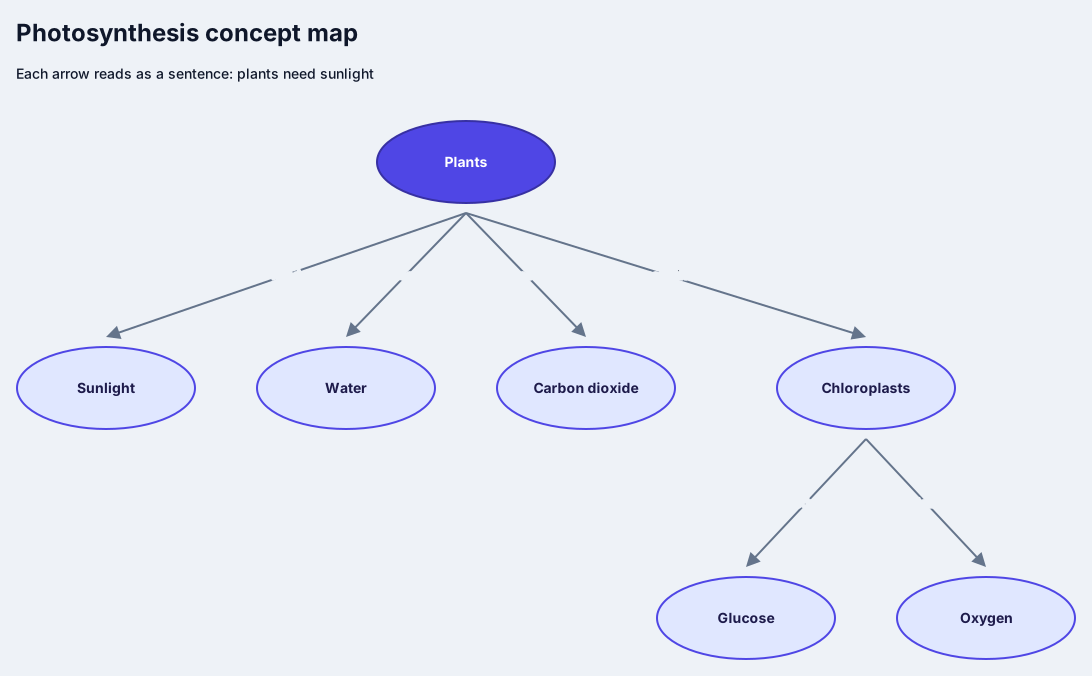
A concept map links ideas with labelled arrows so each connection reads as a sentence. This template explains photosynthesis: plants need sunlight, water, and carbon dioxide, contain chloroplasts, and produce glucose and oxygen. Every arrow carries a verb, so the map can be read aloud.
Unlike a mind map, a concept map is not a tree. Any concept can link to any other, which makes it good for showing how a system works and for checking understanding. Swap the example for your own subject, keep the verbs on the arrows, and the map doubles as a study sheet.
Replace the central concept with your topic and the surrounding concepts with its key ideas.
Draw arrows between related concepts and label each one with a verb or short phrase.
Read every connection aloud as a sentence and fix the ones that do not make sense.
Share the map with your class or team, or export it as an image for handouts.
A mind map grows outward from one central idea as a tree. A concept map can connect any idea to any other and labels every link, so it shows relationships instead of just hierarchy.
Yes. The example uses nine nodes, well inside the 15 diagram nodes plus 150 notes, text, stickers, and mind map topics that Free allows per diagram.


Sign in with Google or GitHub. Free for a single seat. Upgrade when the team joins.