Use case
SWOT analysis
Strengths, weaknesses, opportunities, and threats on one structured board: a SWOT analysis your team can revisit, not a slide that goes stale.
Scenario
A product lead is preparing a quarterly strategy review: what the product does well, where it is weak, which markets are opening up, and which competitors and costs threaten the plan.
Drop sticky notes into the four quadrants of a SWOT board; the zone under your cursor lights up as you drag, and the board grows instead of squeezing your notes. Keep PESTLE or Porter’s five forces on the same canvas. Share a branded public link or export SVG/PNG; Pro adds embed and watermark-free PDF/JPEG.
What you draw
SWOT analysis
- A SWOT board with strengths, weaknesses, opportunities, and threats
- One sticky note per point, in the quadrant where it belongs
- A PESTLE board for the external factors behind opportunities and threats
- Porter’s five forces when competition needs a closer look
- Stickers on the points the team agrees matter most
- Next steps beside the board for the strategy owner
Why Archboard
Archboard is a hosted diagram workspace with zoned boards: notes stay in their quadrant, the board never shrinks below a readable size, and revision snapshots keep each quarter’s analysis. The same canvas holds the roadmap or plan the analysis leads to.
Packs on this canvas
Boards · Core · Stickers
Every built-in pack is on Free (3 diagrams, 15 diagram nodes + 150 notes, text, stickers & mind map topics each, branded public share, live editing with your AI agents). Pro adds unlimited diagrams and nodes, seats for teammates to edit live, embed, and watermark-free export ($10/seat/month).
Scope
Archboard draws and documents a SWOT analysis; it does not score options, pull market data, or recommend a strategy. The team can edit the board together live, and anyone with the public link can follow along.
How a session goes
Start from the SWOT analysis template after Google or GitHub sign-in
Replace the sample notes with your own points, one per note
Drag notes between quadrants as the discussion moves and mark the ones that matter with a sticker
Share a live link for the review and save a revision for next quarter
Starting template
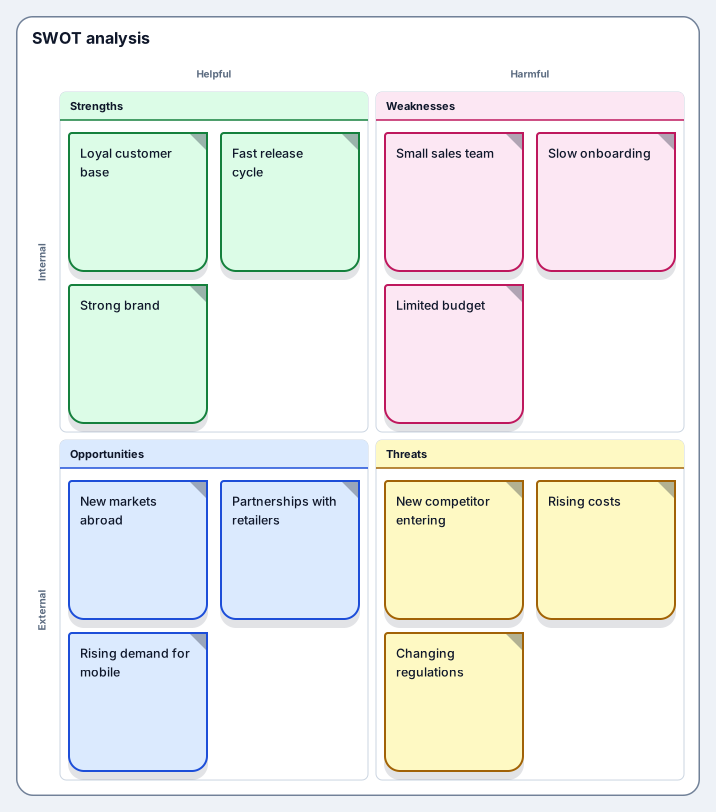
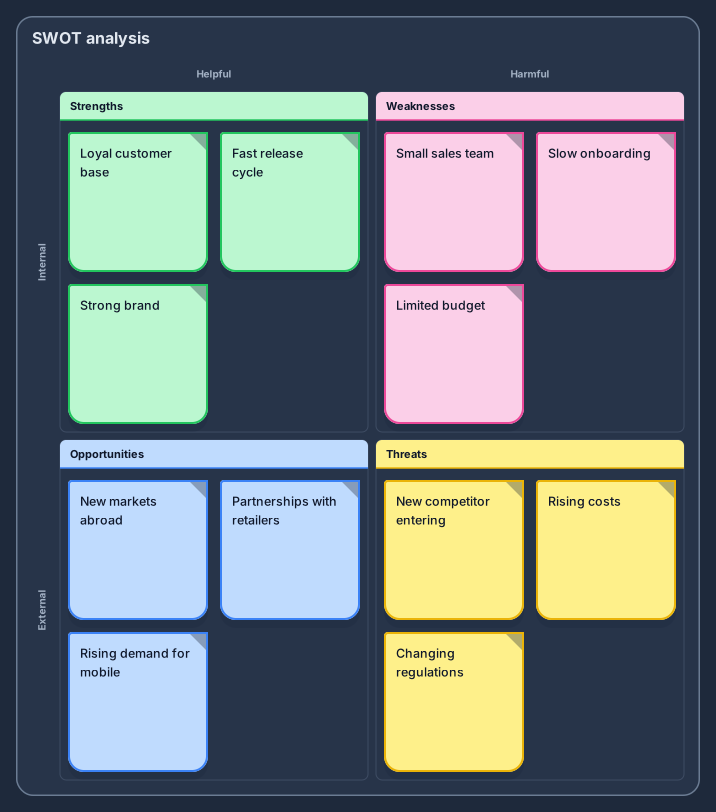
SWOT analysis
The SWOT analysis template opens a board with the four quadrants and three sample notes in each. Replace the samples with your own points and add as many notes as the discussion needs.
Opens an editable copy in your workspace. New to Archboard? Sign in with Google or GitHub and the copy opens right after.
A SWOT analysis that stays in its quadrants
Most SWOT analyses live on a slide: four boxes of bullet points that someone typed after the workshop, already out of date when the next review starts. The discussion that produced them (which strength really matters, which threat is new) is gone. A SWOT board on a hosted canvas keeps the analysis as the team built it. Each point is a sticky note inside the strengths, weaknesses, opportunities, or threats quadrant, and when you drag a note between quadrants, the zone under the cursor lights up so you know where it will land. Add as many notes as the discussion needs: the board grows to fit them instead of squeezing them into unreadable text.
Good SWOT sessions separate the inside from the outside. Strengths and weaknesses describe your team, product, or company today; opportunities and threats describe the market around it. Write one point per note, keep each one specific (a three-week onboarding beats a vague slow onboarding), and resist putting the same idea in two quadrants. When the room disagrees about whether something is a strength or a weakness, write both notes and let the discussion decide. Mark the points that matter most with a sticker, so the summary is visible at a glance.
From SWOT to a strategy you can act on
A SWOT analysis is a starting point, not a plan. Put a PESTLE board next to it when the external factors need more structure, or Porter’s five forces when the threats are mostly competitive. Then turn the strongest opportunities into a now, next, later roadmap or a list of next steps on the same canvas, so the analysis and the plan stay connected. Save a revision snapshot after each review, share a branded public link with stakeholders who were not in the room, and export SVG or PNG for the strategy deck; Pro adds embed plus watermark-free PDF and JPEG.
Founders use a SWOT board before a fundraising round, product managers before a planning cycle, marketing teams before a campaign, and students for case studies. The board title, quadrant names, and template notes are written in the language you work in, across all eight interface languages, so a German or Japanese team never has to translate the template first. Sign in with Google or GitHub, start from the SWOT analysis template, and run the analysis you have been postponing this quarter.
Start from a template
- SWOT analysisFour quadrants with three sample notes each, ready to replace with your own points.
- PESTLE analysisSix columns for political, economic, social, technological, legal, and environmental factors.
- Porter’s five forcesThe five competitive forces around industry rivalry, laid out as a cross.
Questions
What is the difference between a SWOT analysis and a PESTLE analysis?
A SWOT analysis looks at your own strengths and weaknesses and at the opportunities and threats around you. A PESTLE analysis looks only outside, at political, economic, social, technological, legal, and environmental factors. Many teams use PESTLE to fill in the opportunities and threats of a SWOT.
Can I use other two-by-two matrices?
Yes. The Boards pack in the library also has Eisenhower, stakeholder, effort and impact, BCG, and Ansoff matrices, plus a custom two-by-two, all on the same canvas as your SWOT board.
Can several people work on the SWOT board at the same time?
Yes. The team can work on the board at the same time and see each other’s live cursors, and anyone with the public link can follow along. The board autosaves and keeps revisions.
Open a canvas in a minute
Sign in with Google or GitHub. Free for a single seat. Upgrade when the team joins.